A
Experience our Helpdesk AI for 24/7 Facility Service Automation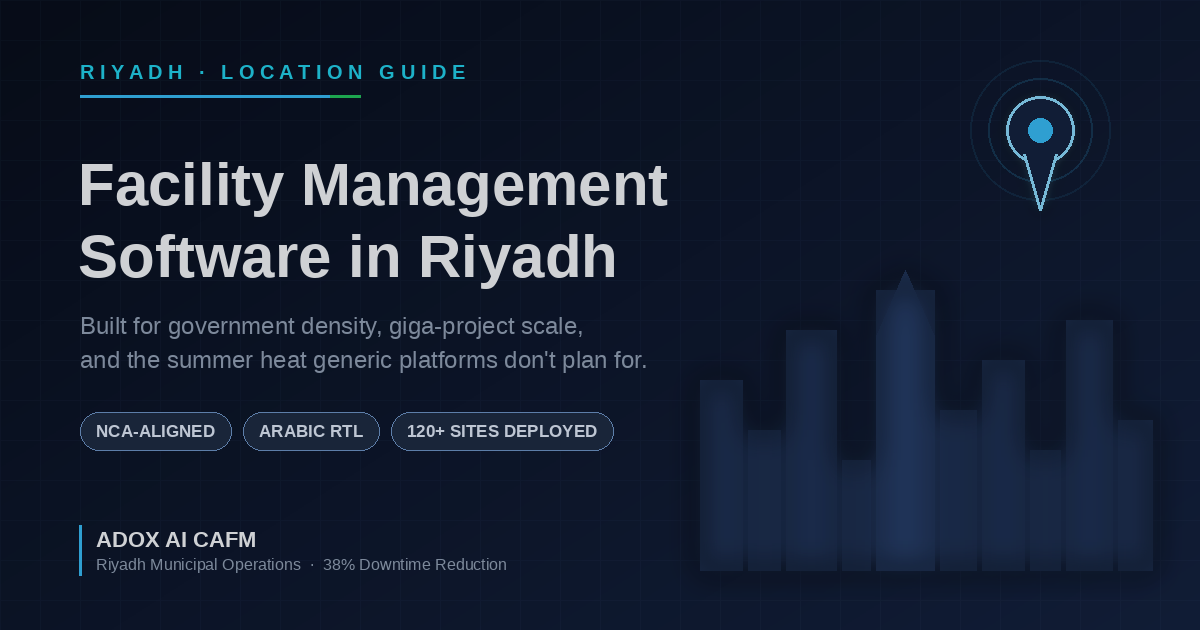
Riyadh isn't a smaller, hotter version of the Saudi facility management market. It's the market's densest concentration of everything that makes generic CAFM software fail here: the highest density of government and ministerial buildings in the Kingdom, a giga-project pipeline running in parallel across the city, and a climate that turns HVAC uptime into a business-continuity issue rather than a maintenance line item.
Facility management software built for Riyadh has to handle all three at once — not as separate feature requests, but as the baseline for operating in this specific city.
A platform that's technically compliant nationwide can still be the wrong fit for Riyadh specifically. Three things set this city apart from the national picture.
Riyadh is the seat of government — the highest concentration of ministries, government agencies, and public-sector facilities anywhere in Saudi Arabia. That matters for facility management software in a very direct way: government and public-sector clients are the segment most likely to require NCA (National Cybersecurity Authority) alignment, Saudi-hosted data infrastructure, and audit-ready access logs as contract terms, not nice-to-haves. A platform that treats these as add-ons rather than defaults is going to lose exactly the tenders where Riyadh has the most volume.
Riyadh is running several giga-scale developments in parallel: King Salman Park, New Murabba (the Mukaab downtown redevelopment), Diriyah Gate, and Qiddiya just outside the city. New Murabba's full build-out has a long runway — its 2025 revised timeline pushes full completion to 2040 — but its first phase is explicitly tied to a much nearer deadline: Riyadh is hosting World Expo 2030. That single date is doing a lot of quiet work across the city's facility management sector right now, because Expo 2030 means new venues, upgraded transit infrastructure including the Riyadh Metro network, and a wave of commercial and hospitality builds all needing to be operational on the same calendar.
The practical implication for facility software: Riyadh has an unusually large number of buildings moving from construction handoff into live operations in a compressed window. Platforms that can onboard a new facility fast — asset mapping, work order setup, compliance configuration — have a real advantage over ones built around the assumption that a building's operational profile barely changes year to year.
Riyadh summers aren't just hot — average highs run 40–45°C from May through September, with peaks that have hit nearly 49°C, against humidity as low as 10%. Air conditioning in Riyadh isn't a comfort feature, it's core infrastructure, and HVAC failure during peak summer is closer to an operational emergency than a maintenance ticket.
This is where predictive maintenance stops being a sales pitch and starts being the actual point. A platform that can flag a compressor showing early failure signs in June, before it fails in the middle of August, is solving a problem specific to this climate — not a generic feature that happens to also work here.
The clearest example of what this looks like in practice is a deployment across Riyadh's municipal operations — more than 120 sites under a single facility management team, spanning public buildings, community facilities, and municipal infrastructure.
Before the platform switch, the team was managing maintenance requests, asset records, and compliance documentation across a patchwork of spreadsheets and manual processes stretched across 120+ locations — the kind of setup that works until it doesn't, usually right when summer heat pushes every HVAC system in the portfolio toward failure at once.
After deploying ADOX AI CAFM across the full site portfolio, with centralized work order management, asset tracking, and AI-assisted predictive maintenance scheduling, the team cut maintenance downtime by 38%. For a municipal operation managing public facilities at that scale, that's not an abstract efficiency number — it's the difference between a maintenance issue getting caught on a predictive schedule versus becoming a public-facing service failure.
That deployment also had to clear the same bar every Riyadh government-adjacent facility does: NCA-aligned data handling, Saudi-hosted infrastructure, and a genuinely Arabic-first interface for the teams actually filing and closing work orders in the field.
A shorter list than a full national buyer's guide, because these are the criteria that matter most for this city in particular:
For the fuller national-level evaluation criteria and a platform comparison table, see the Best CAFM Software in Saudi Arabia: 2026 Buyer's Guide.
Is there facility management software built specifically for Riyadh, or just for Saudi Arabia generally? Most platforms market at the national or GCC level. What actually matters for Riyadh specifically is whether the platform handles the city's particular conditions well: NCA-aligned compliance for government-heavy portfolios, fast onboarding for the wave of new builds tied to Expo 2030 and the city's giga-projects, and predictive maintenance calibrated for extreme summer heat — not a separate "Riyadh edition" of the software.
How does Riyadh's climate affect facility management software requirements? Riyadh's summer heat (regularly 40–45°C, with recorded peaks near 49°C) puts sustained stress on HVAC and cooling systems for months at a time. Facility management software with AI-based predictive maintenance can flag equipment showing early failure signs before a breakdown during peak summer load — a meaningfully different requirement than in a moderate climate where preventive maintenance can run on a simple calendar schedule.
What compliance requirements apply to facility management software used by government or municipal clients in Riyadh? Government and public-sector facilities in Riyadh typically require alignment with the National Cybersecurity Authority's Essential Cybersecurity Controls (NCA ECC), Saudi-hosted data infrastructure, and demonstrable access controls and audit logging. See the full NCA & ZATCA compliance checklist for the specific items to verify with any vendor.
How fast can facility management software be deployed across a large Riyadh portfolio? Deployment timelines depend heavily on the platform's architecture. Purpose-built, cloud-native platforms with pre-configured templates can bring a large multi-site portfolio — the Riyadh municipal deployment referenced above covered 120+ sites — online in weeks rather than the 6–18 months common with legacy enterprise platforms.
Does facility management software in Riyadh need to support Arabic? For most deployments involving government, municipal, or field maintenance teams, yes — and it needs to be genuine right-to-left interface support, not a translated layer over an English-first product. Field technicians and facility supervisors working primarily in Arabic notice the difference immediately in day-to-day use.
See how ADOX AI CAFM handled 120+ sites for Riyadh municipal operations — [book a demo](/book-demo) to walk through the deployment, or explore the full [platform](/platform) for a technical breakdown.
Join 500+ GCC enterprises using ADOX AI CAFM to reduce costs, eliminate downtime, and build smarter facilities. Deployment starts in 4 weeks.